
Just because a routine works for someone else doesn’t mean it’ll work for you, and that’s because it all depends on your own unique hair type. Finding your specific hair type and choosing your haircut around it can be done in a few simple steps.
Know Your Hair’s Porosity
Hair porosity is your hair shaft’s ability to absorb and retain moisture, divided into low, medium and high. Low porosity hair means the cuticles are really tight and don’t let anything in.
Medium porosity hair means the cuticles are slightly raised, so moisture is easy to absorb and retain.
High porosity hair has constantly raised or completely broken cuticles, so moisture is super easy to absorb but nearly impossible to retain.
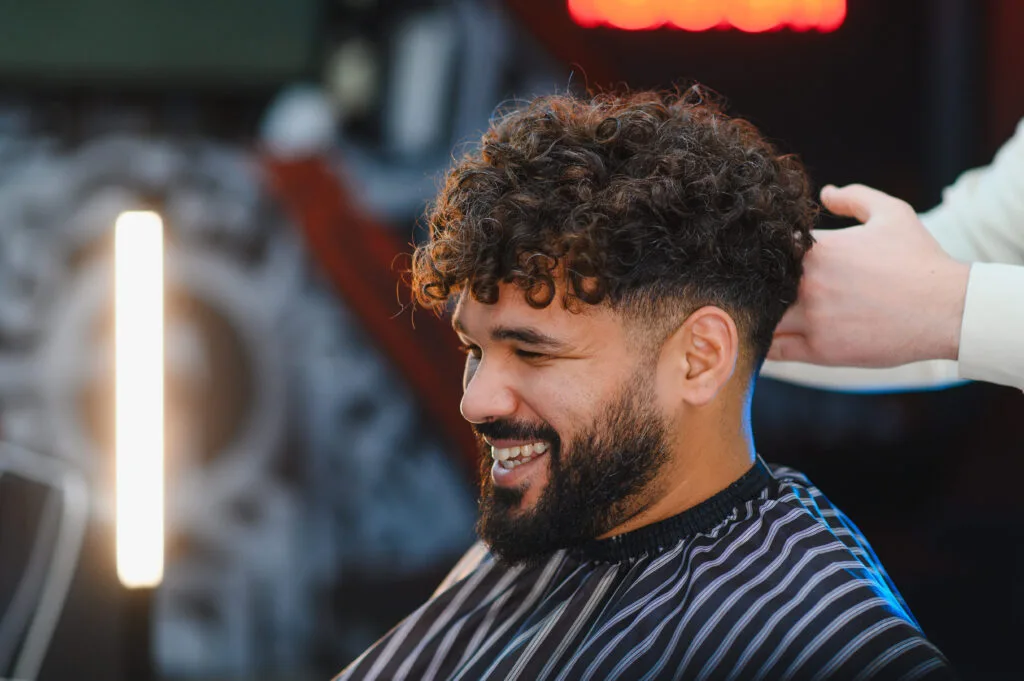
We work with all types of hair!
The next time you shower, notice how fast or slow your hair gets wet. If it takes a long time to get wet, that’s a sign of low hair porosity, and your hair may also take a long time to dry, usually about 2 hours.
If you have very high hair porosity, your hair will get wet really fast and dry really fast, usually about 30 minutes, and you might tend to have more frizzy, fried, or damaged hair that’s more open to breakage.
Know Your Hair Texture
Take one strand of your hair, place it between your fingers, rub your fingers together, and see what you feel. If you can’t feel anything, you most likely have really fine hair. If you can feel something but it’s extremely light, you probably have medium. If it feels like touching a wire cord, you have very coarse hair.
Fine hair breaks a lot more easily, so drying and brushing need to be done very carefully. Medium textured hair still needs gentle drying and brushing, but is a lot less prone to breakage. Coarse hair is obviously a lot stronger, though it’ll probably be very stiff once dry and will probably frizz up very easily.
Know Your Hair Density
Hair density is how thick or thin your hair is overall, divided into thin, medium and thick. To test it, part your hair and pull it to one side a little, then check how visible your scalp is. If you can see your scalp very easily, you have thin hair. If a little bit of scalp is visible, you’re probably in the medium range. If you can’t see it at all, you have thick-density hair.
Understand Your Curl Pattern
A gene inside you determines how straight or curly your hair is, but it gets more complex than that. There are four different hair types: straight, wavy, curly and kinky. Then there are different subtypes based on how loose or tight your curls are. Straight hair is the easiest; it’s type one.
It’s either straight or it’s not. For the next types, there are 2A, 2B and 2C, based on how loose or tight the waves are. For group three hair, there are 3A, 3B, and 3C, and 3C is when your hair starts to get a little coily. For group four, there are 4A, 4B, and 4C, and 4C is the tightest coils possible, though you can also have a combination of hair types.
To find out your curl pattern, next time you wash or condition your hair, just let it air dry, no heat tools, nothing, and once it gets completely dry, you’ll easily be able to find out what curl pattern your hair falls under. Keep in mind: the longer your hair is, the looser your curls will get because the weight of your hair will pull them down.
Know Your Scalp Moisture Level
Scalp moisture level is how dry or oily your scalp is, based on natural sebum production, and can depend on factors like overwashing or genetics. There are four types: balanced, dry, oily, or combination. If you have balanced hair, it probably gets dry after 3 or 4 days of not washing. A dry scalp could dry up within 24 hours and can be very itchy or flaky.
Choosing a Haircut That Works With Your Face Shape
Once curl pattern, porosity, texture, density and moisture level are known, this helps choose the right products, like shampoos, conditioners and styling products formulated for that specific hair type, and also helps figure out whether a hairstyle seen on someone else will actually work, since it depends on whether that person’s specific hair type matches.
The idea with face shape is to always go the opposite. For a round face, a spiky haircut, messy wave style, side part or brushed-up hair works, along with a medium or high fade to keep the sides short. For a square face, a buzz cut, modern flat top, undercut or gentleman’s cut works, and close-cropped curls or a quiff for curly hair.